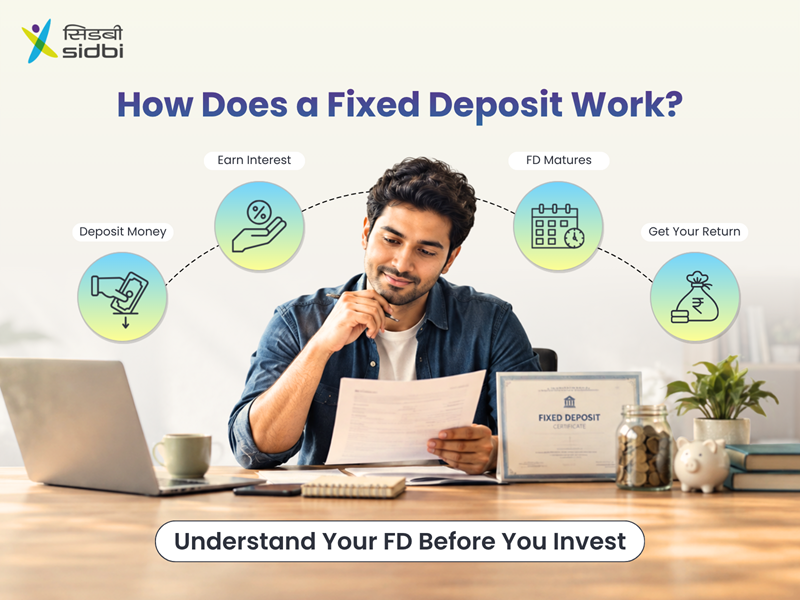
How Does a Fixed Deposit Account Work? A Complete Guide for Beginners
A fixed deposit, or FD, is one of the simplest ways to grow your savings. You give the bank a fixed amount for a fixed period, and the bank pays you interest on it.
Beginners choose FDs because there are no surprises. The rate is locked on the day you book, so you know your maturity amount in advance, and your money does not move with the share market. Banks lend this money to people and businesses and share a part of that earning with you.
This guide covers FD basics, benefits, the working process, and the points to check before you open one.
What Are Fixed Deposits?
A fixed deposit is an account where you deposit a lump sum with a bank for a set period and earn a fixed rate of interest. Tenures can run from a few days to ten years, and the rate stays the same for the full term even if market rates change later. The day the term ends is the maturity date, when your money is returned with interest.
Types of Fixed Deposits
- Regular FD: the standard option, with flexible tenure choices.
- Tax-saving FD: has a five-year lock-in and offers a tax benefit on the amount invested, as per the rules in force.
- Senior citizen FD: for customers above a certain age, usually at a slightly higher rate.
- Cumulative and non-cumulative FD: interest is paid at maturity in the first, and at regular intervals in the second.
Why Fixed Deposits Are a Trustworthy, Stable Choice
Your Money Is Put to Work, Not Left Idle
When you open an FD, the bank doesn't just hold your money — it lends it out to other individuals and businesses. This is exactly why the bank can offer you a fixed, guaranteed return in the first place: it knows how your deposit will be used and can commit to a rate in advance, unlike investments where returns depend on unpredictable market movements.
Backed by a System Built for Stability
FDs work because banks depend on deposits like yours to function. This makes deposit-taking one of the most tightly regulated and closely watched parts of a bank's business, which is part of why FDs are seen as one of the safer places to keep your savings.
A Return That Doesn't Change With the Market
Your FD rate is fixed the day you book it and stays that way for the entire tenure, regardless of what happens to loan demand or interest rates afterward. That's the trade-off at the heart of an FD: in exchange for locking your money in, you get a return that isn't watching the market — it's already decided.
How Do Fixed Deposits Work?
Step 1: Choose the Fixed Deposit Amount
Decide how much you can set aside comfortably. Keep enough in your savings account for emergencies, and invest the rest based on your goal.
Step 2: Select the FD Tenure
Tenures usually start from seven days and go up to ten years. Pick a period that ends around the time you will actually need the money, so you are not forced to break the deposit early.
Step 3: Bank Calculates Interest
The bank applies the rate in force on the booking date. Your rate depends on:
- The deposit amount
- The tenure chosen
- The bank's own rate card and policy
- Your customer category, such as senior citizen
Step 4: Interest Accumulation During the Tenure
In a cumulative FD, interest is added back to the deposit and earns further interest, which is compounding. In a non-cumulative FD, interest is paid out at the chosen interval and does not compound.
Step 5: Maturity and Withdrawal Process
On the maturity date, the principal and interest are credited to your linked account. Most banks also let you renew the deposit for another term.
Advantages of Getting a Fixed Deposit
- Guaranteed Returns on Investment — You can calculate your maturity amount on day one, and market ups and downs do not change what you receive.
- Safe and Low-Risk Investment Option — FDs suit conservative savers who want safety first. Bank deposits are also covered by deposit insurance up to a specified limit per depositor per bank.
- Flexible Investment Tenure — Match the tenure to the goal: a short FD for a planned purchase, a longer one for a future need.
- Regular Income Through Interest Payments — Non-cumulative deposits pay interest monthly, quarterly, half-yearly, or yearly, which helps retired people and anyone who wants a predictable inflow.
- Helps Build Financial Discipline — Since the money is locked for a fixed period, you are less likely to dip into it, which builds a saving habit and keeps unplanned spending in check.
Fixed Deposit Interest Calculation Explained
Simple Interest vs Compound Interest in Fixed Deposits
Simple interest is calculated only on the principal, while compound interest is calculated on the principal plus the interest already earned. For example, ₹1,00,000 at 7% for one year earns ₹7,000 as simple interest; if it compounds quarterly, the earnings are slightly higher. Short deposits often use simple interest; longer ones usually compound.
Factors That Affect Fixed Deposit Returns
- The amount invested
- The interest rate offered
- The duration of the deposit
- The type of FD selected
Things to Consider Before Opening a Fixed Deposit
- Compare Interest Rates — Rates differ across banks and tenures, so check a few rate cards before booking.
- Understand Lock-In Period — A tax-saving FD cannot be withdrawn for five years. A regular FD can be broken, but only at a cost, so choose the tenure carefully.
- Check Premature Withdrawal Rules — On early withdrawal, banks usually pay interest for the period the deposit actually stayed and may deduct a penalty. Read this clause before booking.
- Consider Tax Implications — AAA-Rated Fixed Deposit interest is taxable, and banks deduct tax at source once interest crosses the applicable threshold in a financial year. Tax-saving FDs offer a deduction on the amount invested, subject to current rules.
Final Thoughts: Is a Fixed Deposit Right for You?
A fixed deposit works on a simple idea. You keep a set amount with the bank for a set time; the bank uses it for lending, and you earn a return known from day one. That makes it a good fit if you want safety and a predictable maturity value. Before booking, compare rates, choose a tenure that matches when you will need the money, and read the withdrawal and tax rules.
Frequently Asked Questions About Fixed Deposits
1. Is a fixed deposit a safe investment?
Yes. Returns are fixed in advance, and bank deposits are protected by deposit insurance up to the specified limit.
2. How much money can I invest in a fixed deposit?
Banks accept deposits from a small minimum amount, and a regular FD has no upper limit. Tax-saving FDs have a yearly limit.
3. Can I withdraw my fixed deposit before maturity?
A regular FD can usually be closed early, with a lower rate and a possible penalty. A tax-saving FD cannot be withdrawn during the lock-in.
4. Do fixed deposits earn monthly interest?
Yes, if you choose a non-cumulative FD with a monthly payout. A cumulative FD pays everything at maturity.
5. What happens after my FD matures?
The principal and interest are credited to your account, or the deposit is renewed if you have chosen auto-renewal.
6. Are fixed deposit returns taxable?
Yes. FD interest is added to your income and taxed as per your slab, with tax deducted at source beyond the applicable limit.


