Starting or expanding a business requires funding for infrastructure, machinery, working capital, and growth. However, many MSMEs and entrepreneurs face difficulties in accessing formal credit.
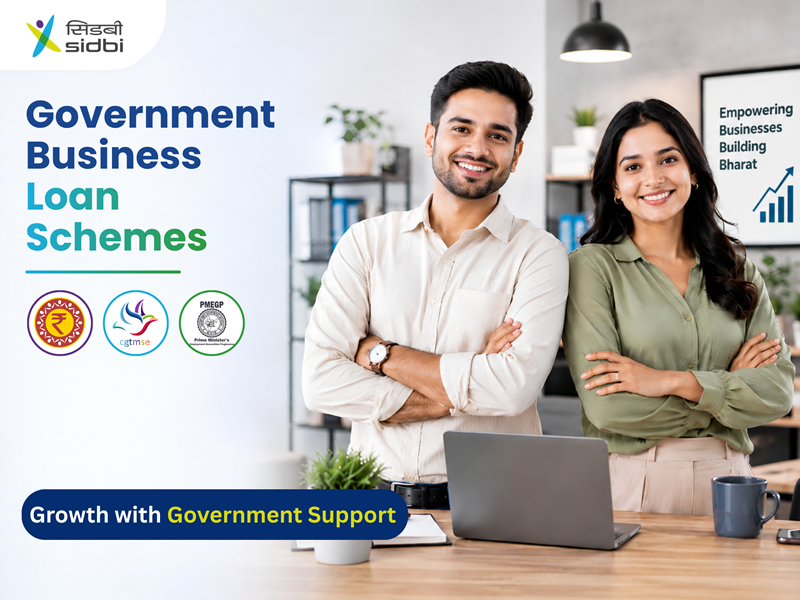
To address these challenges, the Government of India has introduced business loan schemes that support MSMEs, startups, and emerging businesses by improving access to finance. SIDBI also contributes to MSME development by providing financial solutions that help businesses grow and strengthen their operations.
What Are Government Business Loan Schemes?
Government business loan schemes are financing initiatives introduced to improve access to formal credit for businesses. These schemes are generally implemented through banks and financial institutions to provide entrepreneurs with financial assistance for establishing, operating, modernising, or expanding their businesses. By encouraging institutional lending, these schemes help reduce funding challenges that may otherwise limit business growth.
Government-supported business finance also promotes greater financial inclusion by enabling businesses to access organised sources of credit instead of depending solely on informal financing channels. As a result, entrepreneurs are better positioned to invest in productive assets, strengthen operations, and pursue long-term growth opportunities.
How These Schemes Support MSME Growth
Government business loan schemes contribute significantly to the growth of India's MSME sector by improving access to formal finance. Easier availability of credit allows entrepreneurs to invest in business infrastructure, purchase equipment, manage working capital requirements, and expand their operations as their businesses grow.
These initiatives also encourage first-time entrepreneurs to establish new ventures by improving access to institutional finance. Existing businesses benefit from financing that supports business expansion, technology adoption, and operational improvements. Collectively, these efforts contribute to employment generation, strengthen local economies, and support the overall development of the MSME sector.
Key Government Business Loan Schemes Available in India in 2026
1. Pradhan Mantri Mudra Yojana (PMMY)
Pradhan Mantri Mudra Yojana (PMMY) is one of the government initiatives aimed at supporting businesses through institutional finance. The scheme seeks to improve access to credit for eligible businesses and entrepreneurs, helping them meet their financial requirements during different stages of business development.
Categories Under PM Mudra Loan
Under PMMY, financial assistance is provided through three categories that correspond to different stages of business growth:
- Shishu
- Kishor
- Tarun
Who Can Benefit from PM Mudra Yojana?
The scheme is intended to support several categories of businesses and entrepreneurs, including small traders, service providers, micro manufacturing units, and new entrepreneurs seeking business finance. The specific eligibility conditions and coverage under the scheme require additional official information.
2. Credit Guarantee Fund Trust for Micro and Small Enterprises (CGTMSE)
The Credit Guarantee Fund Trust for Micro and Small Enterprises (CGTMSE) provides credit guarantee support to eligible businesses. By supporting lending institutions through a credit guarantee mechanism, the scheme helps improve access to finance for MSMEs while reducing collateral-related challenges that businesses may face when applying for loans. The availability of credit guarantee support encourages lending to eligible enterprises and contributes to greater access to institutional finance for the MSME sector.
Eligibility for CGTMSE Support
The scheme supports eligible micro enterprises, small businesses, and qualifying MSME activities. However, the complete eligibility conditions vary according to official scheme guidelines.
Why CGTMSE is Important for MSMEs
Credit guarantee support improves credit availability by encouraging financial institutions to extend loans to eligible MSMEs. By addressing collateral-related financing challenges, the scheme contributes to business growth and enables enterprises to access formal sources of finance more easily.
3. Prime Minister Employment Generation Programme (PMEGP)
The Prime Minister Employment Generation Programme (PMEGP) is a government initiative aimed at promoting entrepreneurship by supporting the establishment of new micro-enterprises. The programme encourages self-employment by helping eligible entrepreneurs set up new business ventures in different sectors of the economy. Through this initiative, the government seeks to generate employment opportunities while strengthening the micro-enterprise ecosystem across the country.
By encouraging the creation of new enterprises, PMEGP contributes to local economic development and supports individuals who wish to start their own businesses. The programme plays an important role in promoting entrepreneurship, particularly among first-time business owners.
Businesses Covered Under PMEGP
The programme supports a variety of business activities, including manufacturing units, service enterprises, and rural businesses. These categories reflect the programme's focus on encouraging entrepreneurship across different sectors and regions.
PMEGP Loan Eligibility Requirements
The eligibility requirements under PMEGP depend on the official scheme guidelines and may include applicant-specific conditions, business-related requirements, and prescribed documentation. Since these details have not been provided, they cannot be included here without referring to the official scheme.
4. Stand-Up India Scheme for Women and SC/ST Entrepreneurs
The Stand-Up India Scheme has been introduced to promote inclusive entrepreneurship by improving access to business finance for eligible entrepreneurs. The scheme focuses on supporting individuals who wish to establish new enterprises and aims to encourage wider participation in entrepreneurial activities.
By facilitating access to institutional finance, the scheme contributes to creating a more inclusive business ecosystem while encouraging entrepreneurship among eligible applicants.
Who Can Apply Under Stand-Up India?
The scheme is intended to support women entrepreneurs, entrepreneurs belonging to the Scheduled Castes (SC), Scheduled Tribes (ST), and eligible greenfield enterprises.
5. Startup India Funding Support
Startup India is an initiative that focuses on strengthening India's startup ecosystem by encouraging innovation and entrepreneurship. The initiative supports recognised startups and seeks to create an environment where innovative businesses can grow and contribute to economic development.
Innovation-driven enterprises often require specialised support during different stages of growth. Startup India aims to facilitate this ecosystem by providing recognised startups with access to various forms of support.
How Startup India Helps Emerging Businesses
Startup India contributes to the development of emerging businesses by supporting funding access, providing recognition benefits, and strengthening the overall entrepreneur support ecosystem.
SIDBI Loan and Financial Support for MSMEs
The Small Industries Development Bank of India (SIDBI) serves as the principal financial institution for the promotion, financing, and development of the MSME sector. It plays an important role in improving access to finance by offering a range of financial products designed to address the diverse requirements of MSMEs throughout different stages of business growth.
According to the information available on the SIDBI website, the institution offers financial solutions across multiple business requirements. These include term loans, working capital assistance, machinery finance, equipment finance, receivable finance, green finance, renewable energy finance, cluster development support, startup support, and several other financing solutions intended for MSMEs.
Comparison of Popular Government Business Loan Schemes
The following table provides a broad comparison of some of the major government business loan schemes discussed above.
| Scheme | Suitable For | Main Purpose |
|---|---|---|
| PM Mudra Yojana | Small businesses | Micro business funding |
| CGTMSE | MSMEs | Credit guarantee support |
| PMEGP | New entrepreneurs | Setting up enterprises |
| Stand-Up India | Women and SC/ST entrepreneurs | Inclusive business growth |
| Startup India | Startups | Innovation and entrepreneurship |
| SIDBI Finance | Growing MSMEs | Business expansion |
What Are the Documents Required to Apply
- Identity Proof – Aadhaar card, PAN card, or other valid identification documents
- Address Proof – Residential or business address verification documents
- Business Registration Documents – Proof of business ownership or registration
- Udyam Registration Certificate – For eligible MSME businesses
- GST Documents – GST registration and related documents, wherever applicable
- Recent Bank Statements – To assess financial transactions and repayment capacity
- Business Plan or Project Report – Details of business activities, funding requirements, and growth plans
- Additional Documents – Lenders may request extra documents depending on the scheme, business type, and loan requirement
Common Challenges Entrepreneurs Face While Applying for Business Loans
Lack of Proper Business Documentation
One of the most common challenges faced by entrepreneurs during the loan application process is incomplete or inaccurate business documentation. Missing records or insufficient documentation may delay the processing of an application or require applicants to submit additional information before their request can be evaluated.
Choosing an Unsuitable Loan Scheme
With several government business loan schemes available, selecting the most appropriate option can sometimes be difficult. Each scheme has its own objectives, eligibility conditions, and intended beneficiaries. Understanding these differences before applying can help entrepreneurs identify the financing option that best aligns with their business requirements.
Poor Financial Planning
Businesses should assess their funding requirements carefully before applying for finance. A clear understanding of the purpose of the loan, projected business requirements, and repayment obligations can contribute to better financial planning and more informed borrowing decisions.
Not Maintaining Credit Records
Maintaining proper financial and credit records may be beneficial when applying for institutional finance. Depending on the lending institution and the applicable scheme, credit history may form part of the overall assessment of the loan application.
Conclusion: Supporting India's Entrepreneurs Through Accessible Finance
Government business loan schemes play an important role in strengthening India's entrepreneurial ecosystem by improving access to institutional finance. These initiatives support businesses at different stages of growth, encourage entrepreneurship, and contribute to the development of the MSME sector through improved access to credit.
Alongside these government initiatives, SIDBI continues to support MSMEs through a wide range of financial products designed to address diverse business requirements. By offering financing solutions that support business growth and development, SIDBI contributes to the promotion and financing of the MSME sector across the country.
Frequently Asked Questions About Government Business Loan Schemes
1. Which government business loan scheme is best for small businesses?
There is no single scheme that is suitable for every business. The most appropriate option depends on factors such as the nature of the business, its stage of development, financing requirements, and eligibility under the respective government scheme.
2. Can entrepreneurs get government business loans without collateral?
Some government initiatives are designed to improve access to finance by addressing collateral-related challenges. However, collateral requirements depend on the specific scheme and the lending institution.
3. Which government loan scheme is suitable for starting a new business?
Different government schemes are intended to support new businesses and entrepreneurs. The appropriate scheme depends on the applicant's eligibility, the nature of the proposed business, and the objectives of the scheme.
4. Are government business loan schemes available for women entrepreneurs?
Yes, government initiatives have been introduced to encourage entrepreneurship among women. The Stand-Up India Scheme is one such initiative mentioned in this article.
5. How can MSMEs apply for government loan schemes?
The application process varies depending on the scheme and the participating lending institution. Entrepreneurs should review the official eligibility criteria, documentation requirements, and application procedures before applying through the designated channels.