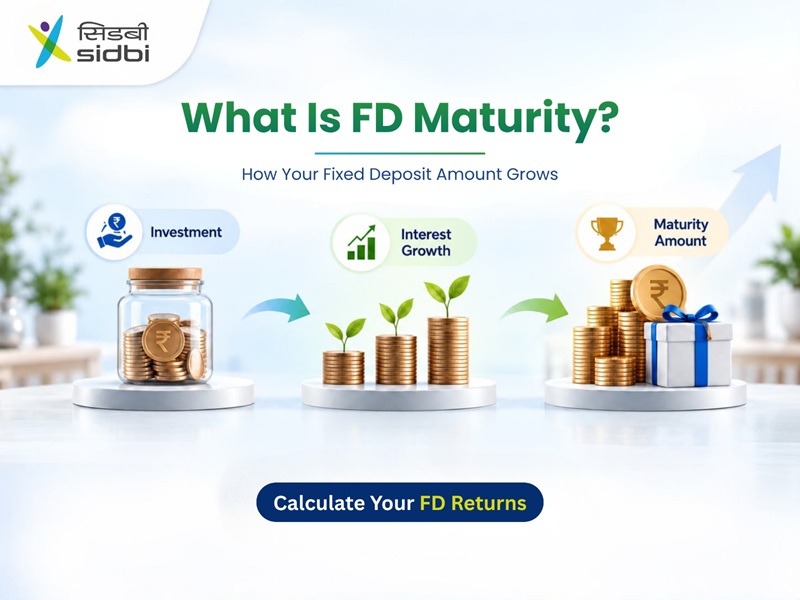
What Is FD Maturity? How Is Fixed Deposit Maturity Amount Calculated?
A fixed deposit (FD) lets you earn interest on your money for a fixed period. The interest rate usually stays the same for the whole tenure. This makes it easy to know in advance how much money you will get back.
The day your FD tenure ends is called the maturity date. On that day, you become eligible to receive your principal amount along with the interest earned. Knowing how FD maturity works helps you plan your money and estimate your returns before you invest.
What Is FD Maturity?
FD maturity means the end of the fixed deposit tenure you chose at the start. Think of it as the day your FD finishes its job. Your money has stayed invested for the full period, and now you get it back along with the interest.
Three terms are useful to know:
- Deposit date: The day you invest.
- Maturity date: The day your chosen tenure ends.
- Maturity amount: The total amount you receive, which is your principal plus the interest earned.
For example, if you invest ₹1,00,000 for five years, the day your five-year term ends is the FD maturity date. On that date, you receive the principal along with the interest earned on it.
What Is FD Maturity Date?
The maturity date depends on two things: the date you made the deposit and the tenure you chose.
For example, if you open a two-year FD on 10 March 2026, it will mature on or around 10 March 2028. The exact date is mentioned in your deposit confirmation.
Tracking the maturity date helps you:
- Plan where the money will be needed
- Decide whether to withdraw or renew the deposit
- Avoid missing the date and leaving the money idle
How Is Fixed Deposit Maturity Amount Calculated?
Your maturity amount depends on four things:
- Principal amount: The money you invest at the start. A higher principal earns more interest at the same rate.
- Interest rate: The yearly rate offered on the FD. A higher rate gives a higher maturity amount.
- Investment tenure: The length of the deposit. A longer period gives interest more time to grow. Rates can differ by tenure, so check the rate for your chosen period.
- Compounding frequency: How often interest is added to your principal. It can be monthly, quarterly, half-yearly, or yearly. The more often interest is compounded, the slightly higher your maturity amount will be.
Fixed Deposit Maturity Amount Calculation
For a cumulative FD, the maturity amount is calculated using this formula:
M = P × (1 + r/n)(n × t)
Where:
- M = Maturity amount
- P = Principal amount
- r = Annual interest rate in decimal form (for example, 7% = 0.07)
- n = Number of times interest is compounded in a year (monthly = 12, quarterly = 4, half-yearly = 2, yearly = 1)
- t = Tenure in years
FD Maturity Calculation Example
Let us take a cumulative FD with these details:
| Detail | Value |
|---|---|
| Principal Amount | ₹1,00,000 |
| Interest Rate | 7% per year |
| Tenure | 5 years |
| Compounding | Quarterly |
Steps:
- Quarterly interest rate = 7% ÷ 4 = 1.75% (0.0175)
- Number of quarters = 4 × 5 = 20
- M = 1,00,000 × (1 + 0.0175)20
- Maturity amount ≈ ₹1,41,478
- Total interest earned ≈ ₹41,478
Because the interest rate is fixed, you can work out your FD maturity amount in advance, which is not possible with market-linked options, as explained in our guide on fixed deposit vs mutual funds.
Types of FD Maturity Payout
| Feature | Cumulative FD | Non-Cumulative FD |
|---|---|---|
| Interest | Added to the principal and paid at maturity | Paid out at regular intervals |
| Payout Options | One lump sum at maturity | Monthly, quarterly, half-yearly or yearly, depending on the scheme |
| Suitable For | Investors who do not need regular income | Investors who want regular income from their deposit |
Cumulative FD: Your interest keeps earning interest until maturity, so you get a larger lump sum at the end.
Non-Cumulative FD: You receive interest during the tenure, so you get regular income. At maturity, you receive your principal along with the last interest payout, if due.
Options After FD Maturity
When your FD matures, you can usually choose from these options:
- Withdraw the full amount: Take the principal and interest back into your account.
- Renew the deposit: Reinvest for a new tenure. The interest rate will be the rate applicable at the time of renewal, which may be different from your earlier rate.
- Use the money elsewhere: Move the amount to another investment or use it for your goal.
Check the issuer's terms in advance to know what happens if you do not instruct the maturity date. Some issuers may renew the FD automatically, while others may credit the amount to your account.
Before you invest or renew, it also helps to know the common errors people make with their deposits, which we cover in our guide on how to avoid fixed deposit mistakes.
Frequently Asked Questions About FD Maturity
1. What is FD maturity?
FD maturity is the end of your chosen fixed deposit tenure. On this date, you become eligible to receive your principal amount along with the interest earned.
2. How is the FD maturity amount calculated?
For a cumulative FD, it is calculated using the formula M = P × (1 + r/n)^(n × t). It depends on your principal, interest rate, tenure, and compounding frequency.
3. What can I do when my FD matures?
You can withdraw the full amount or renew the FD for a new tenure, as per the issuer's rules.
4. Does the maturity amount include interest?
Yes. In a cumulative FD, the maturity amount includes your principal and the interest earned. In a non-cumulative FD, interest is paid out during the tenure, and you get your principal back at maturity.
5. How can I find my FD maturity value?
You can use an FD maturity calculator. Enter your deposit amount, interest rate, tenure and compounding frequency to get an estimate of your maturity amount.


