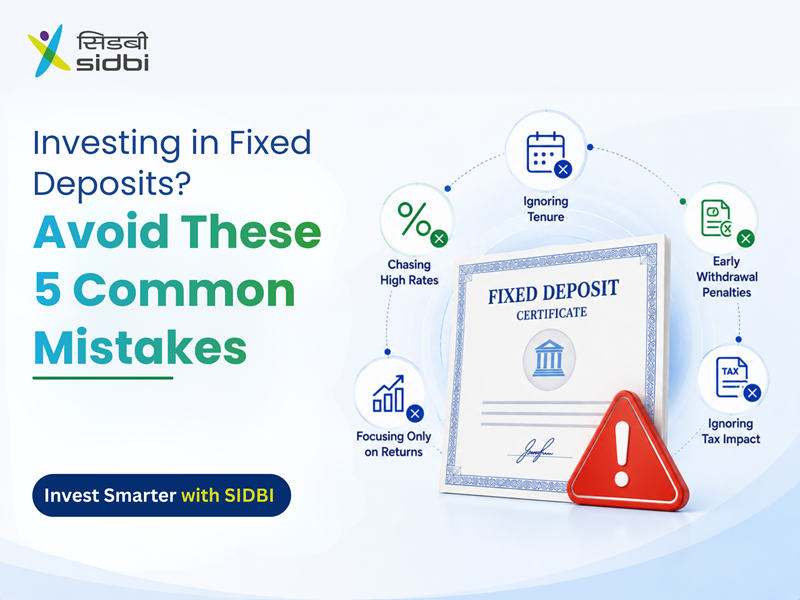
5 Common Mistakes to Avoid While Investing in Fixed Deposits
Fixed Deposits are often seen as the "safe, set-it-and-forget-it" part of a portfolio, and for good reason. The returns are predictable and the principal isn't exposed to market swings. But "safe" doesn't mean "mistake-proof."
A surprising number of investors lose out on returns, pay avoidable tax, or find themselves short of cash at the wrong time. This happens not because FDs are risky, but because of how they're used. Here are five mistakes worth watching out for.
1. Putting All Your Money Into a Single FD with One Tenure
It's tempting to book one large FD and forget about it, but locking your entire corpus into a single tenure means all your money becomes illiquid at once. It also means you're stuck with today's interest rate for the entire duration, even if rates rise later.
The fix most seasoned investors use is called FD laddering: instead of one large deposit, you split the amount into several smaller FDs with staggered maturities. For example, one maturing in 1 year, another in 2 years, another in 3 years, and so on.
This way, a portion of your money is always coming up for renewal, giving you periodic access to funds and letting you reinvest maturing deposits at whatever the prevailing rate is at that time, rather than being locked into one rate for years.
2. Ignoring Premature Withdrawal Penalties and Lock-in Terms
Many investors book an FD without checking the exit terms, assuming they can pull the money out anytime with no real cost. In reality, most FDs charge a penalty on premature withdrawal, commonly a reduction of around 0.5% to 1% on the interest rate. Some tax-saving FDs under Section 80C come with a mandatory 5-year lock-in with no premature withdrawal allowed at all.
Before booking an FD, match the tenure to when you'll actually need the money. If there's a real chance you'll need a portion of it earlier, it's often better to split it into smaller deposits (again, laddering helps here) rather than book one large FD and risk breaking it early, losing interest in the process.
3. Overlooking TDS and Not Submitting Form 15G/15H (or Form 121) on Time
FD interest is fully taxable at your income tax slab rate, and banks deduct Tax Deducted at Source (TDS) once your total interest income crosses a threshold:
- ₹50,000 a year for regular depositors
- ₹1,00,000 a year for senior citizens
These limits apply across combined deposits with that bank. If your PAN isn't linked, the TDS rate can be even higher.
A lot of investors whose actual income is below the taxable limit still end up having TDS deducted simply because they forgot to submit the exemption declaration at the start of the financial year. If your total income is genuinely below the taxable threshold, you're expected to submit Form 15G (for those below 60) or Form 15H (for senior citizens) at each bank where you hold a deposit, ideally by April 1st.
Note that from FY 2026-27, these two forms are being unified into a single self-declaration, Form 121, under the new Income Tax Act, 2025. Keep an eye on which form your bank asks for going forward.
Missing this step doesn't mean you overpay tax permanently, since you can claim a refund when filing your return. But it does mean your money sits with the tax department instead of earning for you until the refund comes through.
4. Not Comparing Rates and Safety Ratings Across Institutions
Because FD rates feel like a small, boring number, many investors simply renew with whichever bank they already use, without comparing what's available elsewhere. Rates can vary meaningfully across banks and tenures, and even a difference of half a percentage point compounds into a noticeable amount over a 3–5 year deposit.
At the same time, chasing the highest advertised rate without checking the credit rating of the institution is its own mistake. Look for deposits rated AAA or equivalent by agencies like CARE, CRISIL, or ICRA. This rating reflects the institution's ability to repay both principal and interest reliably.
A slightly lower rate from a AAA-rated, well-capitalised institution is often the more sensible trade-off than chasing an unusually high rate from an unrated or lower-rated one.
5. Treating FD Interest as "Tax-Free" or Forgetting to Declare It
Unlike some other savings instruments, FD interest gets no special tax treatment. It is added to your total income under "Income from Other Sources" and taxed at your regular slab rate, whether or not TDS was deducted.
Some investors assume that if no TDS was cut (because interest stayed below the threshold, or a 15G/15H was filed), the interest is somehow tax-free. It isn't. No tax was deducted upfront, but you're still required to declare it and pay tax on it if your total income is taxable.
This mistake tends to catch people with FDs spread across multiple banks. Each bank deducts TDS (or not) based only on the interest it individually pays you, but your total tax liability is based on your combined interest income from all sources. Keeping a simple running tally of interest earned across all your deposits each financial year makes it much easier to declare accurately and avoid a notice later.
Getting the Basics Right
None of these mistakes are about FDs being a poor investment choice — they're about using a simple product carelessly. Laddering your deposits, checking exit terms before you commit, staying on top of TDS declarations, comparing rates against credit ratings, and declaring interest correctly are all one-time habits that, once built, let an FD do exactly what it's meant to do: protect your capital and deliver steady, predictable returns without any nasty surprises.


