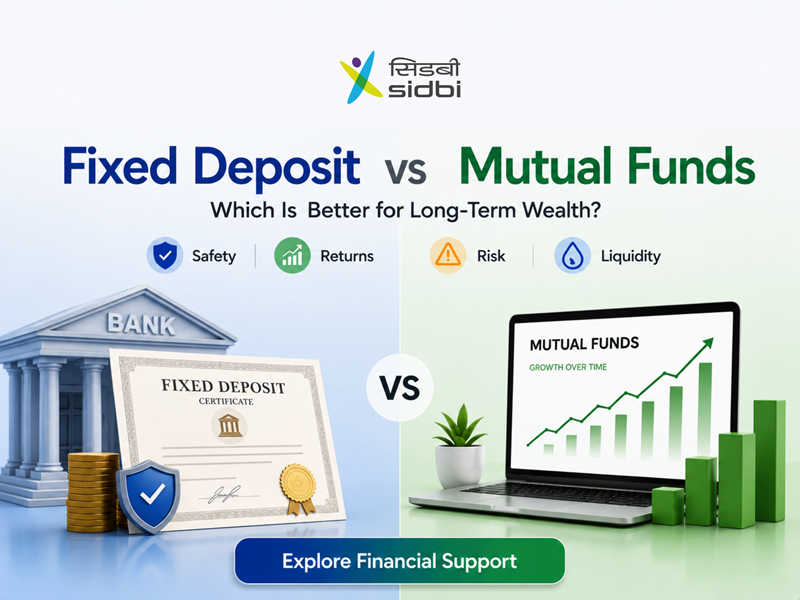
Fixed Deposit vs Mutual Funds: Which Investment Option Is Better for Long-Term Wealth?
Every investor eventually runs into this question: should the money go into something safe and predictable, or something that has the potential to grow faster but with ups and downs along the way? Fixed Deposits (FDs) and Mutual Funds (MFs) sit on opposite ends of that spectrum, and both have a genuine place in a long-term financial plan. The right answer isn't "one is better than the other" in absolute terms — it depends on your time horizon, your comfort with risk, and what you're saving for. Let's break down how each actually works, what the numbers say, and how to decide.
How a Fixed Deposit Works
A Fixed Deposit is a straightforward contract: you deposit a lump sum with a bank or a financial institution for a fixed tenure, and in return, you earn a fixed, pre-agreed rate of interest. There's no ambiguity about what you'll get back at maturity — that's the entire appeal.
Current FD Rates and Safety
Rates vary by institution and tenure. As of mid-2026, large public sector banks such as SBI offer FD rates broadly in the range of about 3% to 6.5% per annum for general citizens, with senior citizens typically earning an additional 0.5% or more on top. Institutions like SIDBI (Small Industries Development Bank of India), which carries an AAA(FD) safety rating from CARE — the highest possible rating for payment of principal and interest — currently offer rates that scale up with tenure, going up to roughly 6.65% per annum (with an effective annual yield of around 6.8% on quarterly compounding) for deposits of 49–60 months, plus an extra 50 basis points for senior citizens. Deposits with such AAA-rated institutions are considered among the safest debt instruments available to retail investors in India, since the rating reflects the very low likelihood of default.
Where FDs Fit In
The strength of an FD is certainty. You know the rate, the tenure, and the maturity amount on day one. There's no market risk — your principal doesn't fluctuate with stock prices or bond yields. This makes FDs a natural fit for money you cannot afford to see shrink: an emergency fund, a down payment you'll need in two years, or a retiree's core income-generating corpus.
The Tax Trade-Off
The trade-off is that FD interest is fully taxable at your income tax slab rate, and it's added to your total income every year it's earned (or at maturity for cumulative deposits), which erodes the real, post-tax return — especially for anyone in the 20% or 30% tax bracket. Over long periods, especially when inflation runs at 5–6%, the real (inflation-adjusted) return on an FD can end up being quite thin, sometimes barely positive.
How Mutual Funds Work
A Mutual Fund pools money from many investors and puts it to work in a portfolio of stocks, bonds, or a mix of both, managed by a professional fund manager. Unlike an FD, there's no promised return — your money moves with the value of the underlying assets, which means it can grow faster than an FD over time, but it can also fall in value, particularly over short periods.
Why Time Horizon Matters
This is precisely why time horizon matters so much with mutual funds. Equity markets are volatile year to year, but historically, over long stretches — ten, fifteen, twenty years — Indian equity markets have delivered returns that have outpaced both FD rates and inflation, though this is not a guarantee and past performance doesn't assure future results. A Systematic Investment Plan (SIP), where you invest a fixed amount every month rather than a lump sum, is the most common way retail investors approach mutual funds, because it smooths out the effect of market swings by buying more units when prices are low and fewer when prices are high.
How Mutual Fund Gains Are Taxed
On taxation, mutual funds work differently from FDs. For equity-oriented funds (those investing at least 65% in Indian equities), gains from units held over 12 months are treated as long-term capital gains (LTCG) and, as of FY 2026-27, are taxed at 12.5% on gains above ₹1.25 lakh in a financial year — anything below that threshold is tax-free. Gains on units sold within 12 months (short-term capital gains) are taxed at 20%. Debt-oriented mutual funds are taxed differently: under current rules, gains are added to your income and taxed at your slab rate, regardless of the holding period. This tax structure means long-term equity mutual fund investors often keep a meaningfully larger share of their gains than FD investors in similar tax brackets, particularly once the ₹1.25 lakh annual exemption is factored in.
Fixed Deposit vs Mutual Fund: Side-by-Side Comparison
| Parameter | Fixed Deposit | Mutual Fund |
|---|---|---|
| Returns | Fixed and pre-known (~3%–6.65% p.a. depending on institution and tenure) | Market-linked; not guaranteed, but historically higher over long horizons for equity funds |
| Safety of principal | High, especially with AAA(FD)-rated institutions | Fluctuates with market value; no capital protection |
| Best suited for | Emergency funds, near-term goals, capital preservation | Long-term goals (7–10+ years) such as retirement or a child's education |
| Liquidity | Premature withdrawal allowed, usually with a lower interest rate | Most open-ended funds redeemable in a few working days (ELSS has a 3-year lock-in) |
| Taxation | Interest taxed yearly at income tax slab rate | Equity LTCG: 12.5% above ₹1.25 lakh/year; STCG: 20%. Debt funds taxed at slab rate |
| Risk level | Low | Low to high, depending on fund category (debt, hybrid, equity) |
| Ideal investment mode | Lump sum for a fixed tenure | Lump sum or SIP (monthly instalments) |
| Predictability | Maturity amount known in advance | Final value known only at the time of redemption |
Comparing the Two Where It Actually Matters
- Safety of principal. FDs, especially with AAA-rated institutions, offer near-certainty on your principal. Mutual funds, particularly equity funds, can and do see negative returns over shorter periods — a fall of 15–20% in a bad year isn't unusual for equity markets.
- Growth potential. Mutual funds, especially equity funds held over long durations, have historically had a real shot at outpacing inflation by a wider margin than FDs. FDs are built for capital preservation, not capital growth.
- Liquidity. FDs usually allow premature withdrawal, though typically with a penalty on the interest rate. Most open-ended mutual funds (barring ELSS tax-saving funds with a 3-year lock-in) can be redeemed within a few working days, often with no exit load after a short initial period.
- Taxation. FD interest is taxed every year at your slab rate. Equity mutual fund LTCG enjoys a lower flat rate (12.5%) with an annual exemption, making it more tax-efficient for long holding periods.
- Predictability. FDs win outright here — you know your return in advance. Mutual funds require you to be comfortable with not knowing your final number until the day you actually redeem.
So, Which One Is Better for Long-Term Wealth?
Framed as "long-term wealth creation" specifically, mutual funds — particularly equity or equity-heavy hybrid funds held for 7–10 years or more through SIPs — have historically had a better chance of building wealth that meaningfully outpaces inflation. The compounding effect of market-linked returns, combined with the more favourable long-term capital gains tax treatment, is why financial planners often lean towards mutual funds for goals that are a decade or more away, such as retirement or a child's higher education.
That said, "better for long-term wealth" doesn't mean FDs have no role. A sensible long-term portfolio usually isn't all one or the other — it's a mix. Fixed deposits with a highly rated institution are well suited for the portion of your money that needs to be safe and available: your emergency fund, near-term goals, or the debt allocation that balances out equity risk in your overall portfolio. Mutual funds are better suited for the growth-oriented portion of your savings, where you have the time to ride out volatility and let compounding work in your favour.
If you're weighing a fixed-income allocation as part of that mix, it's worth comparing tenure-wise interest rates and safety ratings across institutions before locking in your money, since even small differences in rate compound meaningfully over a 3–5 year FD tenure. Whichever path — or combination — you choose, the two things that matter most for long-term wealth are starting early and staying consistent, whether that consistency comes through a recurring SIP or a laddered set of fixed deposits.


