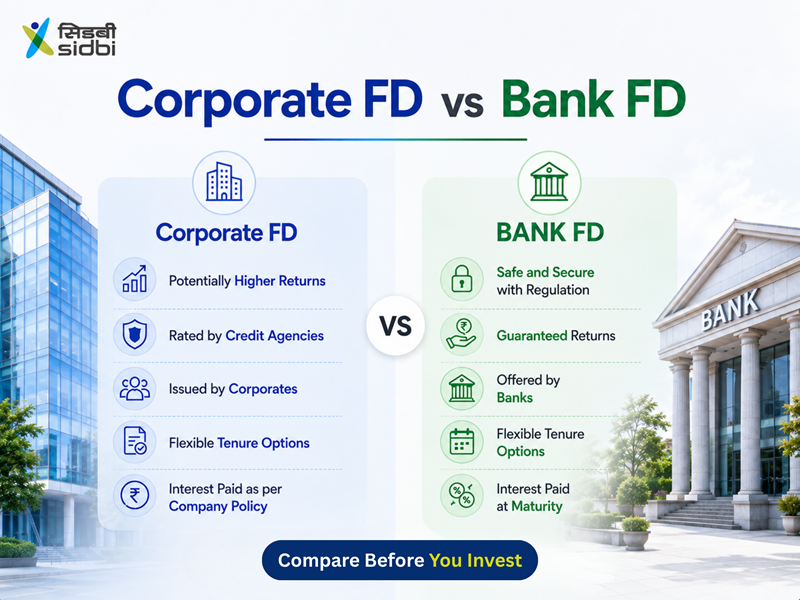
Corporate FD vs Bank FD: Differences, Risks & Benefits Explained
When most people think "Fixed Deposit," they picture a bank counter. But banks aren't the only institutions offering FDs — companies, NBFCs, and government-backed financial institutions offer them too, typically at a noticeably higher interest rate. This raises a natural question: if a Corporate FD pays more, why doesn't everyone simply move their money there? The honest answer is that the extra return comes with a different risk profile, and understanding that trade-off is the whole point of this comparison.
What Is a Bank FD?
A Bank FD is a fixed deposit placed with a scheduled commercial bank for a chosen tenure at a pre-agreed interest rate. It's the most familiar and widely used form of fixed-income investment in India, largely because of one specific protection: deposits with banks are insured by the Deposit Insurance and Credit Guarantee Corporation (DICGC), a wholly owned subsidiary of the RBI, up to ₹5 lakh per depositor per bank. That ₹5 lakh cover applies to the combined total of your principal and interest across all your accounts — savings, current, FD, and RD — held with that one bank. If a bank runs into serious trouble, DICGC is required to pay out the insured amount within 90 days.
Bank FDs generally offer lower interest rates than corporate options, but they're also easy to open, widely available, and come with straightforward premature withdrawal terms (usually a modest interest penalty rather than a lock-in).
What Is a Corporate FD?
A Corporate FD is a fixed deposit offered by a company or a Non-Banking Financial Company (NBFC) as a way to raise funds directly from investors, rather than borrowing from a bank. In 2026, corporate FD interest rates in India broadly range from about 7.5% to nearly 9% per annum for general investors, roughly 1–2 percentage points higher than typical bank FD rates, with senior citizens getting an additional 0.25–0.50% on many schemes.
The catch is that Corporate FDs are not covered by DICGC insurance — that protection is exclusive to banks. Instead, your safety depends entirely on the financial strength and repayment track record of the company or institution issuing the deposit, which is exactly why the credit rating assigned to the FD by agencies like CRISIL, ICRA, or CARE matters so much. A AAA rating is the highest available and signals the strongest capacity to honour both interest and principal repayment on time; ratings step down from there (AA, A, BBB and so on), with each step down implying a somewhat higher chance of delay or default.
Corporate FD vs Bank FD: Key Differences
| Parameter | Bank FD | Corporate FD |
|---|---|---|
| Issuer | Scheduled commercial banks | Companies, NBFCs, and financial institutions |
| Deposit insurance | DICGC-insured up to ₹5 lakh per depositor per bank | No deposit insurance; safety depends on issuer's credit rating |
| Typical interest rates (2026) | Roughly 3%–6.5% p.a. for general citizens | Roughly 7.5%–9% p.a., varying by issuer and tenure |
| Risk factor | Low — backed by RBI-regulated banking system | Depends entirely on the issuer's credit rating and financial health |
| Premature withdrawal | Generally allowed, with a modest interest penalty | Often more restrictive; some issuers limit or disallow early exit |
| Regulation | Regulated by the RBI | Governed by the Companies Act and rated by independent credit agencies |
| Best suited for | Capital safety and predictable, insured returns | Investors seeking higher yield who are comfortable assessing issuer credit risk |
Benefits of a Bank FD
The clearest benefit is regulatory safety — banks operate under close RBI supervision, and the DICGC cover means your deposit (up to the insured limit) is protected even in the rare event of a bank failure. Bank FDs are also simple to open, widely accepted as collateral for loans, and generally offer more flexible premature withdrawal terms.
Benefits of a Corporate FD
The main draw is the rate — a well-rated Corporate FD can meaningfully outearn a comparable bank FD over the same tenure, which matters for investors trying to generate higher fixed income without stepping into market-linked instruments. Many corporate FD issuers also offer flexible tenure options and monthly, quarterly, or annual interest payout choices, which can suit investors who want a regular income stream.
Risks to Weigh Before Choosing
The absence of DICGC cover is the single biggest risk factor with Corporate FDs — if the issuing company faces financial distress, there's no automatic government-backed payout, and recovery (if any) depends on the company's resolution process. This makes the issuer's credit rating the most important factor to check before investing, not the headline interest rate. It's worth treating an unusually high rate from a lower-rated or unrated issuer as a red flag rather than a bargain — in fixed income, a rate that looks too good relative to peers is usually compensating for real credit risk. Liquidity is another factor: some Corporate FDs carry stricter conditions on premature withdrawal than bank FDs, so check the exit terms upfront if there's any chance you'll need the money before maturity.
Making the Choice
The decision usually comes down to how you weigh safety against yield. If capital protection and insured deposits are the priority — say, for an emergency fund or a retiree's core savings — a bank FD remains the more conservative choice. If you're looking to earn a higher fixed return on a portion of your savings and are willing to do the work of checking credit ratings and issuer financials, a Corporate FD with a strong AAA rating from a reputed, well-capitalised institution can be a reasonable way to do that, without taking on the volatility of market-linked instruments.
In practice, many investors don't treat this as an either-or choice — they hold bank FDs for the safety-first portion of their savings and add high-rated corporate or institutional FDs for the portion where they're comfortable trading a small amount of insurance protection for a better rate. Either way, the credit rating on the deposit is the detail worth reading closely before you invest, not just the number on the interest rate.


