

MSMEs play a dual role in the economy by sustaining traditional sectors like manufacturing while spearheading innovation through startups. The traditional handicrafts and village-level enterprises would continue to be relevant by providing sustainable livelihood to a majority of workforce. There is a need to expand the market for such enterprises through concerted efforts of stakeholders. Several sectors such as defence, pharmaceutical, auto-component, clean tech and deep tech industries, as well as labour-intensive ones viz., leather, toy, food processing, can be drivers of MSME growth in achieving the vision of Viksit Bharat by 2047 supported by policy initiatives of the Government.
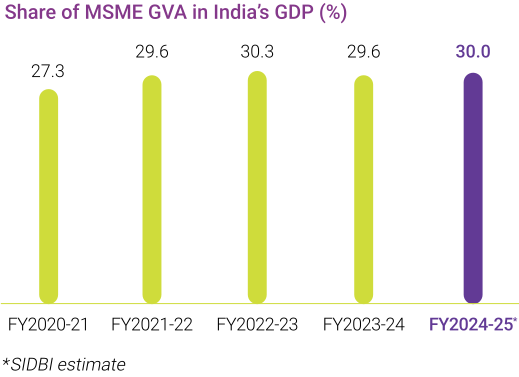
The vibrant MSME sector in India comprises of a wide range of entities from small informal enterprises to sophisticated tech-based startups. To enable integration of informal micro-enterprises (IMEs) into the formal economy, the Government of India (GoI) had introduced the Udyam Assist Platform (UAP). The platform brings the IMEs into the fold of formalisation thus enabling access to benefits such as priority sector lending. The success of the initiative can be visible from the high registrations of over 2.78 crore IMEs (as of August 2025) in around two and a half years of UAP’s operations.
Another noteworthy journey has been of startups in India. India has now become the world’s third-largest startup ecosystem, boasting over 1.57 lakh recognised startups. Remarkably, more than 51% of these ventures originate from Tier II and Tier III cities, collectively providing employment to over 17 lakh2 people. The success of the startup ecosystem can be attributed to the focussed policy initiatives such as Fund of Funds for Startups (FFS) Scheme managed by SIDBI, Atal Innovation Mission (AIM) by Niti Aayog, Startup India Seed Fund Scheme (SISFS) of GoI among others.
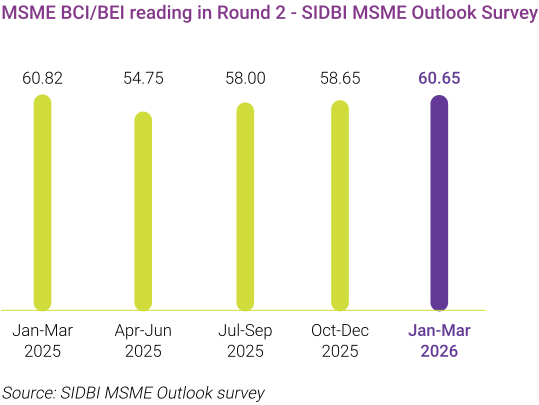
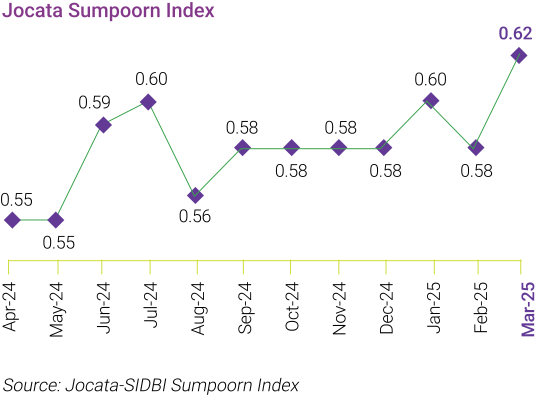
On the performance front, MSMEs exhibited optimistic sentiments about business performance in the prevailing economic environment despite rising uncertainty surrounding tariff impositions as per SIDBI MSME Outlook survey. The MSME Business Confidence Index (M-BCI) rose to 60.82 in Q4FY2025 from 58.30 in Q3FY2025. The index value of all the three sectors viz., Manufacturing, Trading, and Services observed an improvement in the optimism levels in Q4FY2025 as compared to the previous quarter. The one-year ahead expectations also signal optimism with MSME Business Expectation Index (M-BEI) for Q4FY2026 a shade lower at 60.65. The M-BCI and M-BEI are diffusion indices that range, not ranges from 0 to 100, where scores above 50 indicate positive sentiment and scores below 50 suggest negative sentiment. The MSME economic activity as measured from the Jocata-SIDBI Sumpoorn Index also reflect modest expansionary activity of the sector with the index value in the range of 0.55 to 0.62 in FY2025.
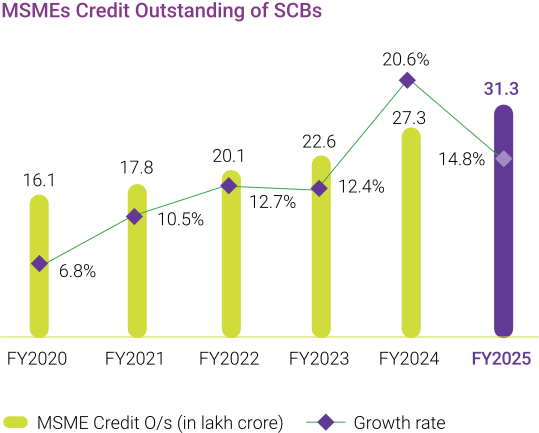
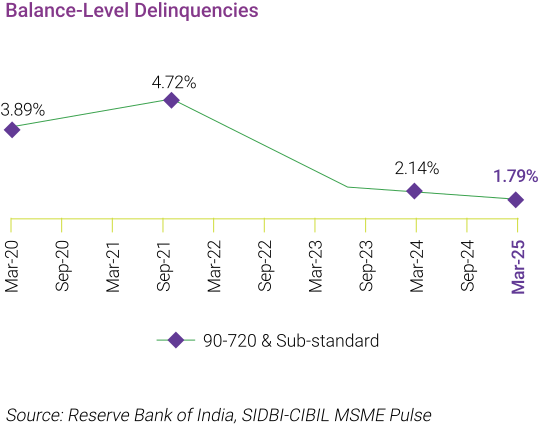
The credit flow to MSMEs by Scheduled Commercial Banks (SCBs) registered steady growth over the past five years. The credit outstanding of the MSME sector was ~2X of the pre-pandemic levels, indicating underlying growth momentum and improved credit appetite for the MSME sector, as of March 2025. In FY2025, the credit outstanding to MSME grew by a healthy 14.8%3 to reach ₹31.3 lakh crore while witnessing a moderation from the high growth seen in the previous fiscal. The MSME credit growth by SCBs was higher than the overall gross advances growth at 11%, positioning it as preferred sector by lenders. The New to Credit (NTC) segment has been a significant contributor to the originations in Q4FY2025 at 47% albeit with a moderation from 51% in Q4FY2024. With 90 day plus delinquencies, declining to a 5-year low of 1.79% as at end of FY20254, the MSME sector is well placed to witness sustainable credit growth over the medium term.
While there has been significant improvement in the credit flow to the MSME sector, SIDBI report on the MSME sector5 broadly estimates the addressable credit gap for the MSME sector at ~₹30 lakh crore. The study further highlights that timely and adequate credit access is a key challenge for the MSME sector (based on survey of ~2,000 MSMEs). The survey findings indicate that borrowing from informal finance continues in the micro segment.
Challenges for the Indian economy and MSMEs are also emerging from the global front. Global growth is projected to remain weak in the near term with World Bank’s forecast of 2.3% in 2025 and a slight uptick to 2.4% in 2026. The trade and tariff policies are creating tensions and uncertainty for economies across the world. The protectionist policies of some of the advanced economies and retaliatory tariffs by other nations could hamper trade, delay investments, disrupt supply chains and put pressure on fiscal policies. Increased geopolitical risks can raise commodity prices particularly that of crude oil and put pressure on the currently low inflation levels. The recent 50% tariff imposition on India in its largest export market, the US is likely to impact the price competitiveness of MSME exporters. While India is taking steps towards mitigating the tariff burden, the interim uncertainty can hit exports in the current year. A relatively larger impact is likely on sectors such as apparels, auto-components and gems & jewellery. Strategic policy and adequate credit support to MSME exporters along with diversification in target markets is essential to enable the sector to navigate the uncertainty.
While the Indian economy is unlikely to remain insulated from the challenging global economic environment, the domestic growth momentum is likely to remain steady in FY2026, with most forecasts pegging growth between 6.3%-6.5%. An expectation of a healthy growth in consumption driven by a favourable monsoon forecast, lower inflation, reduced interest rates and tax concessions to the middle class along with consistent rise in public investments, translate to a positive growth outlook for the Indian economy.
The policy initiatives from the Government will continue to provide support and facilitate a sustainable growth of the Indian MSME sector. The investment and turnover limits for classification of all MSME categories – micro, small and medium, have been enhanced to 2.5 and 2 times respectively, to help them achieve higher efficiencies of scale, get better access to capital and support employment generation. The credit guarantee covers for various categories of MSME borrowers including startups and exporters, have been gradually enhanced to bridge the existing credit gap. Further, in the Union Budget 2025-26, specific policy and facilitation measures for labour-intensive sectors such as footwear and leather, toys and food processing have been proposed. Apart from the traditional sectors, a boost is also being given to the startups in the newer technologies through the announcement of a new fund of funds of ₹10,000 crore.
The outlook for Indian MSMEs remains favourable despite global headwinds supported by strong macroeconomic fundamentals, improving domestic consumption demand, emerging export opportunities through bilateral trade agreements with developed economies, accelerating credit flow and consistent policy support from the Government.
The MSMEs, on their part, need to improve their competitiveness and productivity at a global level. That would require embracing digitalisation in all spheres, upgrading technologies to ensure quality improvement, undertaking sustainability initiatives, encouraging innovation, adopting financial discipline and importantly, building a culture of governance and transparency. Clearly, MSMEs are well poised to emerge as the growth drivers in achieving the vision of ‘Viksit Bharat@2047’.
1Udyam Portal
2 PIB
3 RBI Annual Report FY2025
4 MSME Pulse
5 Understanding Indian MSME sector: Progress and Challenges
Copyright © 2025 Small Industries Development Bank of India(SIDBI)
Designed and Developed by RDX Digital


